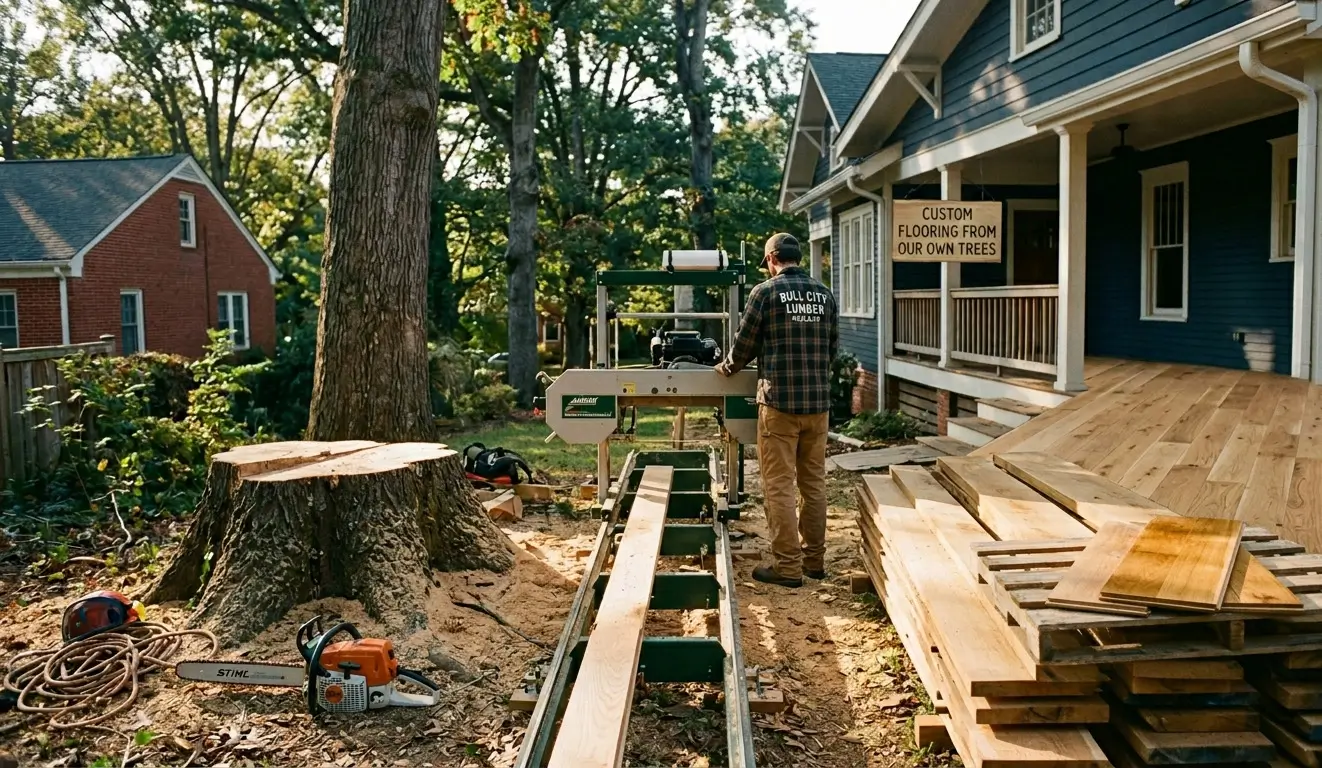
If you’ve spent a July afternoon in Trinity Park or Old North Durham, you know the “vibe” is mostly dictated by the canopy. We live in a city of trees—massive, sidewalk-cracking Willow Oaks that have been here longer than the Lucky Strike chimney.
But let’s be real: those trees aren’t immortal. Eventually, a heavy ice storm or a nasty line of thunderstorms rolls through the Piedmont, and suddenly that backyard Maple is looking less like a shade provider and more like a roof-crusher.
Usually, the drill is simple: call an arborist, pay a couple thousand bucks to have it hauled away, and watch it get turned into a pile of anonymous mulch. But things are changing in Durham. Instead of paying to get rid of their timber, Bull City homeowners are starting to keep it. They’re turning “hazard trees” into custom hardwood floors. Here’s why this DIY-adjacent trend is taking over the 919.
It’s a Durham Thing (The “Story” Factor)
We’re a city that loves a good comeback story—look at the Tobacco District. Repurposing a fallen Oak from your own backyard fits that Durham DNA perfectly. There is a massive difference between buying “Option A” from a big-box store and walking across planks that came from the tree your kids used to swing from. It’s about heritage. You’re not just installing a hardwood floor; you’re preserving a piece of your property’s history.
Beating the “Big Box” Quality
Retail flooring is fine, but it’s often sourced from all over the map and processed to look identical. Our local Durham timber—especially our White Oaks and Walnuts—has a specific character. When you mill your own, you get those wide-plank looks that cost $15+ per square foot in a showroom. You get the knots, the “character” marks, and the grain patterns that actually reflect the North Carolina soil.
Dealing with the NC Humidity
Let’s talk shop: Durham is humid. Most flooring failures happen because wood wasn’t acclimated to our specific swampy air. When you mill and dry your lumber locally, you’re prepping it for the environment it’s actually going to live in. It’s “farm-to-table,” but for your living room.
The Financial “Pivot”
Tree removal in Durham isn’t cheap. If you’re already spending the money to bring a professional crew in with a crane and a crew, why pay extra for them to haul the “waste” away? By diverting those logs to a local sawyer instead of a landfill, you’re essentially subsidizing your own renovation. You turn a removal fee into a raw material win.
How it Actually Works (The “Short Version”)
It’s not as crazy as it sounds.
- The Drop: We start with tree removal, but instead of bucking it into firewood, we save the “saw logs.”
- The Mill: A portable mill (or a local shop) slices it into rough-sawn boards.
- The Kiln: This is the big one. The wood has to be dried so it doesn’t warp later.
- The Install: We sand it down, finish it, and you’ve got a floor that literally nobody else in the world has.
The bottom line? Don’t let your backyard history end up in a wood chipper. If you’ve got a tree that needs to come down, let’s see if it’s got a second life as your new favorite room in the house.